

One pipeline, from panel to proof.
A lightweight agent reads your hardware directly, cross-checks the reading, and issues a tamper-proof certificate all in the time it takes to generate the energy.
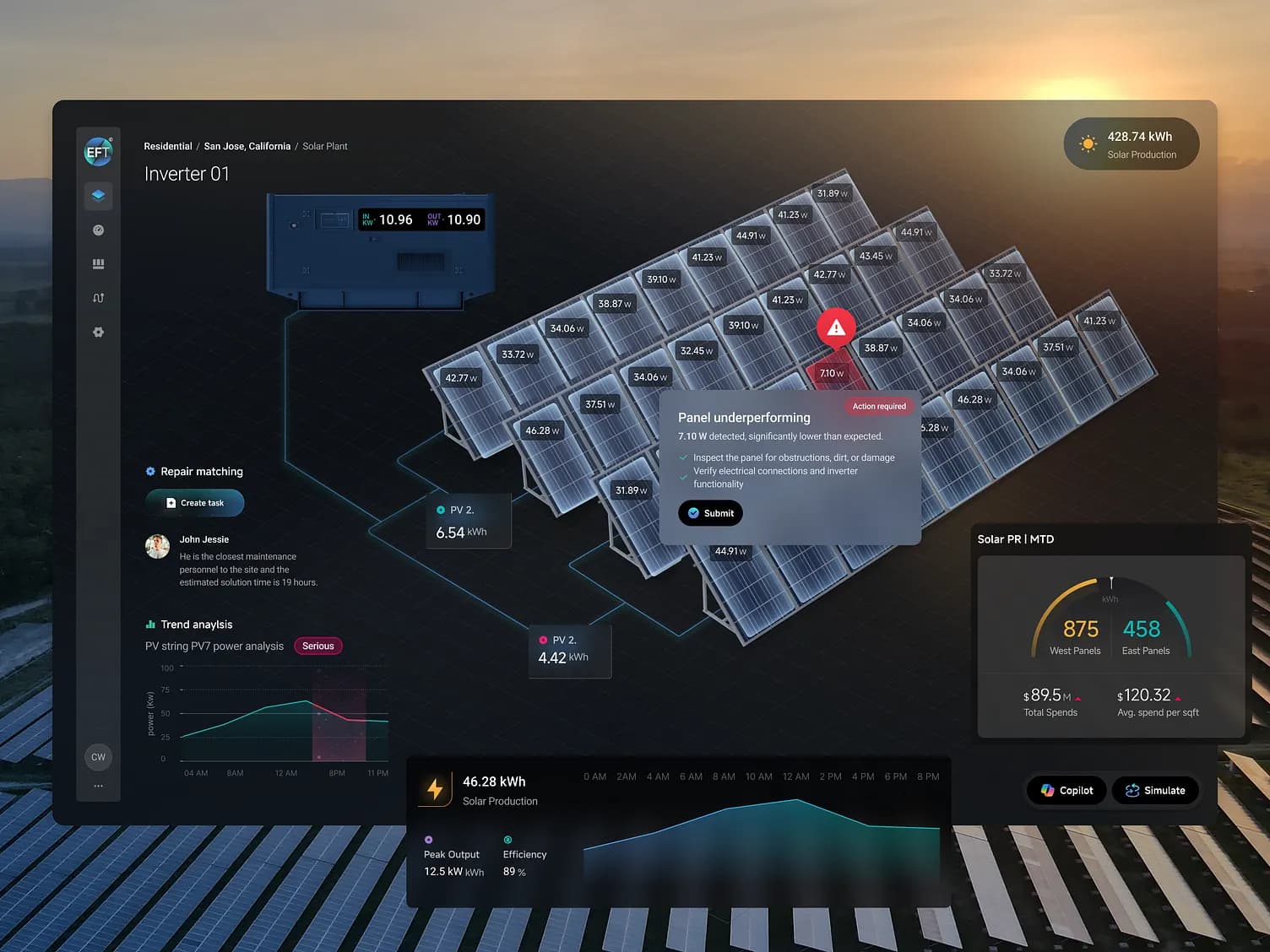
Three modules. One certificate.
Each stage of the pipeline is its own module built to be verified independently, and to work together as a single, seamless hand-off.
GreenProof Edge
A lightweight agent installed on-site, reading inverter and meter data directly from the hardware as power is produced no manual meter readings, no delay.
GreenProof Attest
Output, timestamp, and location are cross-checked against each other on the spot, so a single reading can't be faked, replayed, or quietly edited later.
GreenProof Chain
A verified certificate is minted and delivered instantly on-chain audit-ready, per-kWh, and timestamped, ready to hand straight to a buyer or auditor.
And it gets smarter with scale: every new deployment sharpens the shared model, so customer fifty gets a meaningfully better system than customer five.

Verification you don't have to take on faith.
Fraud-resistant by design
Because the certificate is attested at the hardware, not reconstructed later from a spreadsheet, there's no gap in the chain of custody for someone to exploit.
Get paid in hours, not weeks
Producers stop waiting six to eight weeks for a certificate to clear manual audit verification happens the moment the energy is generated.
An audit-proof record
Every certificate carries its own verifiable history, so compliance teams can answer an auditor's question in minutes instead of re-building a paper trail.
Built like it's protecting real money.
A certificate is only as trustworthy as the system issuing it. We designed ours the way you'd want a financial system designed in layers, with no single point of failure or single person who can override it.
Zero-trust by architecture
Every call between services is authenticated and short-lived there's no 'inside the network is safe' assumption anywhere in the system.
Keys never leave hardware
Signing keys live in dedicated hardware (TPM at the edge, HSM/KMS in the cloud) and are requested, never exported with no single person holding admin control.
Built to be audited
Every privileged action is role-based and independently revocable, and history is never deleted only ever marked invalid so an auditor can always reconstruct what happened.
We're upfront about where we are: the system is designed and tested against its own test suite, but not yet independently audited. A third-party smart-contract audit and a scoped bug bounty are on our roadmap ahead of any mainnet deployment we'd rather say that plainly than overstate where we are today.
Regulation is one driver not the only one.
The EU's CSRD mandate now applies to a smaller, higher-budget set of companies than it did a year ago and that's only part of the demand. Voluntary ESG reporting and non-EU mandates are growing independently of it.
The EU's CSRD Omnibus revision (February 2026) narrowed mandatory scope to companies with over 1,000 employees and €450M+ turnover a few thousand companies, not the tens of thousands originally expected. We think that's worth being upfront about, and it's why we're not building the business case on CSRD alone: voluntary ESG/GHG Protocol Scope 2 reporting and mandates like California's SB 253 are demand sources that don't depend on it.
Four ways we make money, all tied to real usage.
For data centres and industrial firms with mandatory CSRD reporting.
Usage-based pricing for solar farms and wind operators scales with output.
The edge device that reads and attests generation data on site.
Auto-generated, audit-ready reporting for finance and sustainability teams.
Built for the people who make and buy green power.
Solar & wind operators
Get paid faster on verified output, without weeks of manual certification.
Data centres & industrials
Meet CSRD reporting obligations with audit-ready, hardware-verified data.
Energy retailers
Offer customers real-time proof of origin instead of an annual paper trail.
Will these certificates actually be recognised?
Fair question. Full EU regulatory recognition of blockchain-attested certificates isn't confirmed yet so we're deliberate about how we bridge that gap.
CSRD-compatible data layer
Audit-ready exports per-kWh, timestamped, location-verified feed into existing registry submissions, adding hardware proof on top of current workflows.
Dual-track submission
Certificates issue in parallel: one via existing registries using our verified data, one as a GreenProof on-chain token recognised proof today, blockchain proof as an upgrade path.
Direct recognition
We're engaging with EU regulators to position our Triple-Signal Attestation methodology as a recognised standard as reporting rules evolve.
Common questions.
What hardware do I need to get started?+
The GreenProof Edge agent connects to your existing inverter and meter hardware most solar and wind sites don't need new sensors installed, just the agent itself.
How long does installation take?+
For a single site, typically a few hours of on-site setup plus a short remote configuration step. We're refining this further as we onboard our first pilot partners.
Do the certificates work outside the EU?+
Our regulatory work so far is focused on EU frameworks like CSRD, since that's where the compliance deadline pressure is most immediate. The underlying attestation technology isn't EU-specific, and we're open to discussing other markets.
Is this only useful for utility-scale sites?+
No the architecture is built to work for anything from a single commercial rooftop array to a utility-scale wind farm. Pricing and hardware scale with the size of the site.
How is this different from a traditional Guarantee of Origin?+
A traditional GO is typically issued annually or monthly, well after the energy was generated, based on self-reported meter data. GreenProof attests each reading at the hardware in real time, then layers a blockchain-issued certificate on top see our Regulatory Path below for how the two connect.
Aren't there other blockchain-based energy certification platforms?+
Yes this isn't a new category, and we don't pretend otherwise. What we believe sets GreenProof apart is a specific combination: sub-minute, multi-signal attestation at the individual device, privacy-preserving verification that doesn't expose raw site data, and a real-time double-counting guard enforced on-chain. Most existing approaches we've seen address parts of that; we're not aware of another platform combining all three at this granularity.
Want to see it running?
The proof of concept is behind a private access page request it and we'll get you a password.